When companies plan a new production line, attention usually goes to machinery, manpower, and layout design.
Chemicals often come later.
That delay can become expensive.
In manufacturing, laboratory operations, food processing, water treatment, institutional cleaning, and therapeutic production, chemicals are not peripheral — they are operational inputs. Without them, production does not move.
For Malaysian businesses expanding capacity or launching new facilities, structured chemical supply planning should be part of the early-stage strategy — not an afterthought.
This article outlines a practical framework to ensure chemical supply supports growth rather than limits it.
Why Chemical Planning Must Start Early
New production lines typically involve:
- Capital investment
- Equipment installation
- Supplier negotiations
- Operational scheduling
If chemical requirements are addressed too late, common issues arise:
- Delayed start-up
- Incorrect grade ordering
- Insufficient storage space
- Budget overruns
- Compliance gaps
Chemical supply planning affects both operational continuity and financial efficiency.
For companies sourcing industrial chemicals in Malaysia, early engagement with a supplier can prevent these issues.
Step 1: Map All Chemical Requirements
Before calculating quantities, businesses must identify every chemical involved in the new process.
This includes:
- Core process chemicals
- Cleaning and sanitation agents
- Maintenance chemicals
- Testing and laboratory reagents
- Emergency response materials
Many companies only calculate primary production chemicals and overlook cleaning or testing reagents — which later causes procurement delays.

Creating a comprehensive chemical list early improves budgeting accuracy.
Step 2: Determine Consumption Rates Realistically
Estimating usage requires more than theoretical calculations.
You should evaluate:
- Expected daily production volume
- Chemical consumption per unit
- Waste or loss allowances
- Buffer stock requirements
For new facilities, conservative estimates help avoid shortages during the early ramp-up phase.
However, excessive initial stock increases:
- Storage risk
- Expiry exposure
- Cash flow pressure
Balanced forecasting prevents both extremes.
Step 3: Align Grade Selection With Application Requirements
During expansion, businesses sometimes standardise on a single chemical grade for simplicity.
This can be inefficient.
For example:
- Industrial grade may be sufficient for cleaning.
- Laboratory Reagent (LR) may be suitable for routine QC.
- Analytical Reagent (AR) may be necessary for validation testing.
Selecting the correct grade at each stage reduces unnecessary cost without compromising quality.
For facilities operating laboratories, sourcing appropriate laboratory reagents in Malaysia is particularly important during commissioning and validation phases.

Step 4: Plan Storage Infrastructure in Advance
One of the most common expansion mistakes is underestimating storage requirements.
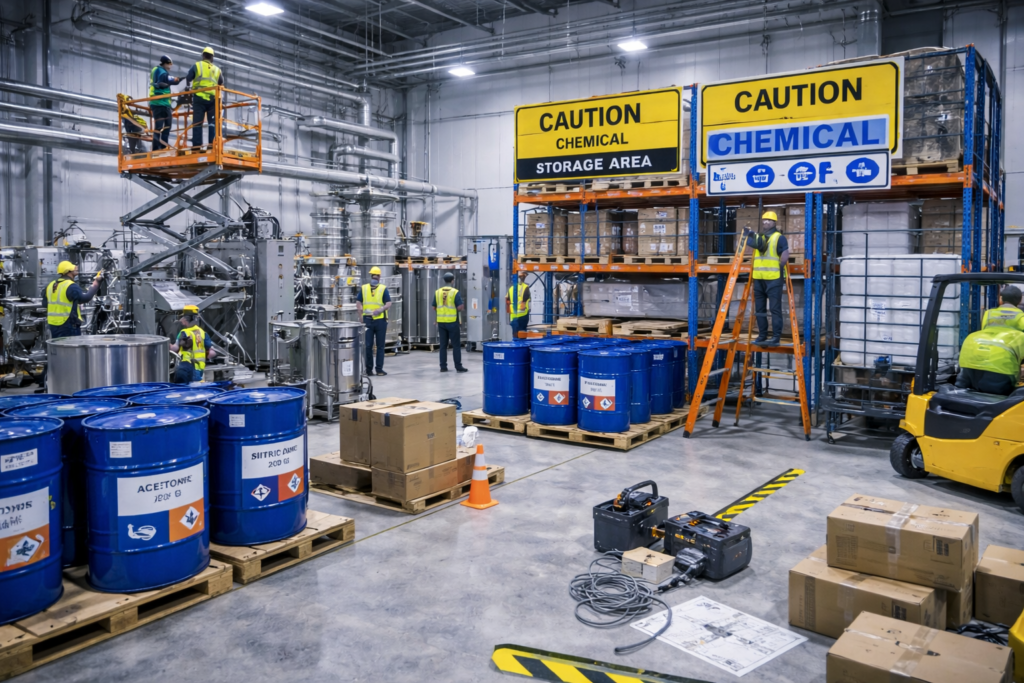
New production lines increase chemical volume. Without adequate storage planning, facilities may:
- Mix incompatible chemicals due to space constraints
- Store chemicals in temporary areas
- Fail segregation requirements
- Create safety hazards
Proper storage planning should include:
- Segregation zones
- Ventilation considerations
- Spill containment measures
- Access control
- Environmental monitoring (if required)
Malaysia’s humid climate makes environmental control especially relevant for sensitive chemicals.
Storage design should scale with production — not lag behind it.
Step 5: Structure Delivery Schedules Strategically
New production lines often begin with fluctuating demand. Consumption during trial runs may differ from full-scale operation.
Instead of ordering large bulk quantities upfront, businesses can consider:
- Phased delivery schedules
- Flexible volume contracts
- Monthly or bi-monthly restocking
- Emergency replenishment arrangements
Structured delivery reduces storage pressure and maintains liquidity.
A reliable supplier can help design a supply schedule aligned with your production ramp-up timeline.
Step 6: Ensure Documentation Readiness for Commissioning
When new facilities go live, documentation requirements often increase.
Auditors or regulatory bodies may request:
- Safety Data Sheets (SDS)
- Certificate of Analysis (COA)
- Batch traceability
- Hazard classification records
Commissioning delays sometimes occur because documentation was not prepared early.
A supplier experienced in supporting industrial and regulated sectors understands these requirements and can assist in preparing documentation packages.
For businesses in therapeutic or regulated manufacturing, this stage is particularly critical.

Step 7: Build Scalability Into Supply Agreements
Expansion rarely stops at one production line.
As volume grows, supply needs change:
- Larger packaging formats
- More frequent deliveries
- Long-term pricing stability
- Improved logistics coordination
Selecting a supplier capable of scaling with your business reduces future procurement disruption.
Short-term pricing advantages are less valuable than long-term supply stability.
Financial Planning: Managing Chemical Costs During Expansion
Chemical supply planning also affects budgeting.
Without structured planning, companies may face:
- Unexpected rush orders
- Price fluctuations
- Waste due to overstocking
- Expiry-related losses
By mapping requirements early and aligning grade selection correctly, businesses can:
- Control procurement cost
- Reduce waste
- Improve financial forecasting
Chemical planning is not just operational — it is financial discipline.
The Supplier as a Growth Partner
During expansion, the role of a chemical supplier evolves.
Beyond delivering products, a capable supplier can support:
- Grade consultation
- Storage planning advice
- Documentation preparation
- Supply scheduling alignment
- Risk mitigation
Early collaboration strengthens operational confidence.
Businesses that treat chemical procurement strategically often experience smoother production launches and fewer compliance issues.
Common Expansion Mistakes to Avoid
Across Malaysian industries, several patterns appear during production expansion:
- Finalising chemical supply only after equipment installation
- Underestimating storage segregation needs
- Over-purchasing high-grade chemicals unnecessarily
- Ignoring documentation until audit stage
- Choosing suppliers based solely on initial pricing
Avoiding these mistakes reduces operational stress during growth.
Final Thoughts
Launching a new production line is a significant investment. Machinery, manpower, and layout design often dominate planning discussions.
But without structured chemical supply planning, even the best-designed production system can stall.
For Malaysian manufacturers, laboratories, and regulated facilities, chemical planning should begin alongside engineering design — not after installation.
A disciplined approach ensures:
- Operational continuity
- Compliance readiness
- Financial control
- Scalable growth
Chemical supply is not just procurement. It is infrastructure.