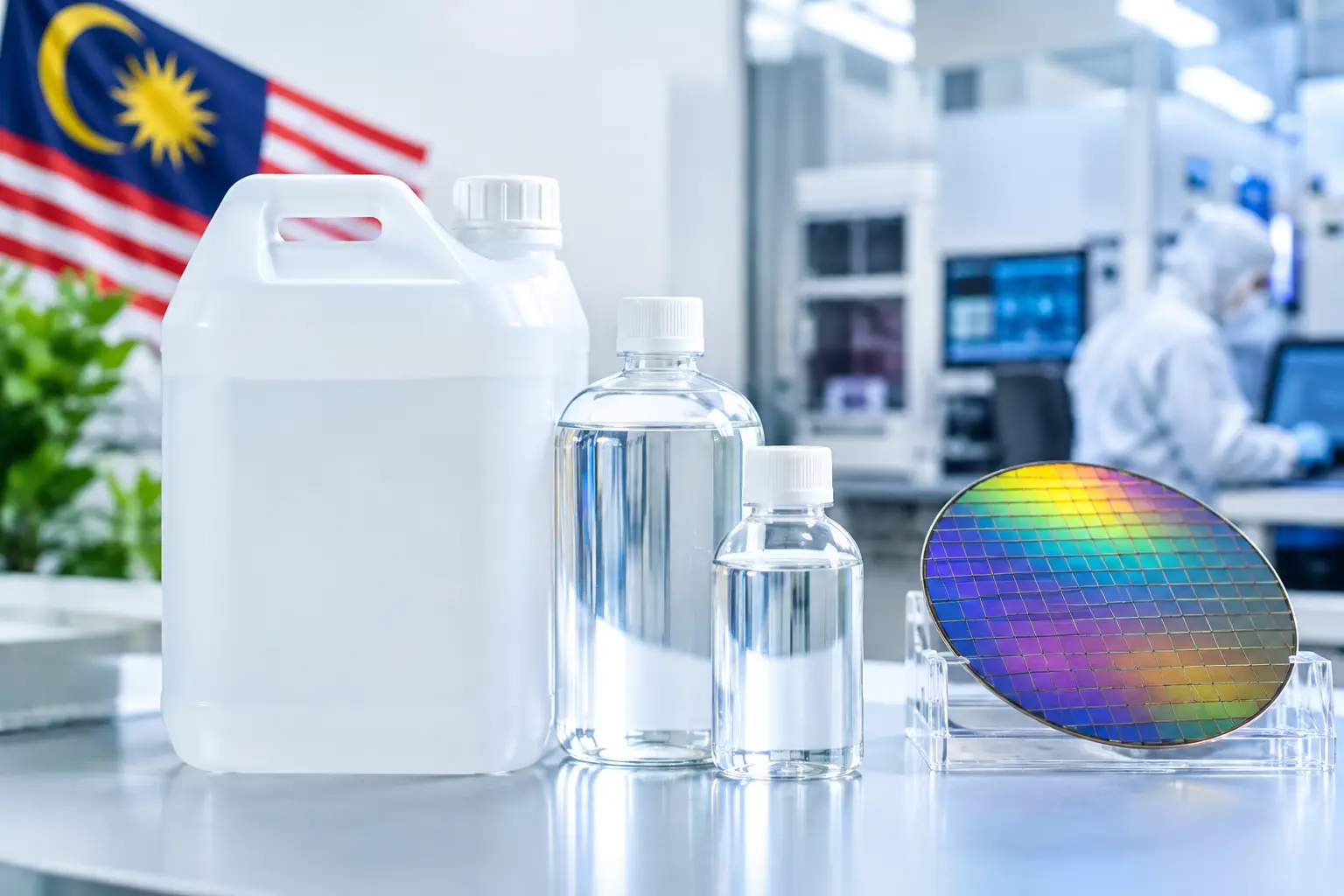
A production line can lose far more than material when a chemical is out of specification. Residue on a printed circuit board, inconsistent etch performance, or a cleaning solvent that leaves contaminants behind can create rework, field failures, and difficult root-cause investigations. Electronics manufacturing chemicals must therefore be selected as controlled production inputs, not as interchangeable commodities.
For procurement, process, and quality teams, the right decision balances chemical purity, application fit, packaging, safety controls, and dependable supply. The required grade is not always the highest available grade. It is the grade that meets the process specification consistently while supporting yield, compliance, and practical operating cost.
Where Electronics Manufacturing Chemicals Affect Quality
Chemical requirements vary significantly across wafer processing, PCB fabrication, component assembly, equipment maintenance, and final cleaning. A material that is suitable for general industrial cleaning may be unsuitable for precision electronics work because trace ionic contamination, moisture, nonvolatile residue, or incompatible additives can affect electrical performance.
In PCB fabrication, acids, alkalis, oxidizers, reducers, and specialty process chemicals may be used for surface preparation, micro-etching, copper treatment, stripping, cleaning, and plating-related operations. Process consistency matters because small changes in concentration or contamination can influence adhesion, etch profile, surface condition, and coating performance.
In assembly environments, solvents and cleaning agents are often chosen to remove flux residues, oils, fingerprints, and process soils. The selection cannot be based on cleaning strength alone. Teams must consider drying behavior, residue profile, material compatibility, worker exposure, ventilation, and whether the process requires a no-clean, aqueous, semi-aqueous, or solvent-based approach.
Wafer and semiconductor-related processes can demand even tighter control. High-purity acids, solvents, bases, and deionized-water-compatible chemicals are used where particles, metals, and ionic contaminants may have direct consequences for device performance. In these applications, supplier documentation, suitable packaging, lot control, and controlled storage are integral to the material specification.
Purity Is a Process Requirement, Not a Marketing Label
Terms such as industrial grade, reagent grade, analytical reagent grade, ACS grade, and electronic grade describe different quality expectations, but they do not automatically determine suitability. A laboratory-grade material may be appropriate for analytical testing yet not qualified for a manufacturing bath. Conversely, a well-controlled industrial-grade product may be appropriate for a defined production operation when its impurity limits match the process requirement.
The critical question is which impurities matter to the application. Metal ions may affect plating or semiconductor performance. Chlorides can contribute to corrosion risk. Water content can change solvent behavior or reactive chemistry. Nonvolatile residue can remain on sensitive surfaces after evaporation. For a cleaning process, a certificate of analysis should be evaluated against the contaminants that can actually cause failure, rather than treated as a generic proof of quality.
Chemical concentration deserves the same attention. A nominal concentration is not enough if the process window is narrow. Procurement and engineering teams should establish acceptable concentration ranges, testing methods, and lot-release expectations before making substitutions. When a product change is necessary, trials should verify cleaning performance, surface effects, electrical behavior, drying time, and downstream compatibility.
Match the Chemical to the Full Process Window
A chemical may perform well in one step and create problems in the next. This is why selection should account for the complete process sequence.
For example, an aggressive cleaner can remove heavy soils effectively but may dull sensitive finishes, affect markings, attack certain plastics, or create rinsing demands that slow throughput. A lower-residue solvent may dry quickly, but it may require improved extraction controls or may not remove all flux types. A more concentrated acid can reduce transport volume, yet it introduces additional dilution control and handling requirements at the point of use.
Compatibility must cover more than the component being cleaned or treated. Review contact with tanks, pumps, seals, dispensing lines, storage containers, wipes, brushes, and personal protective equipment. Elastomers, coatings, metals, and plastics can respond very differently to acids, alkalis, oxidizers, and organic solvents. A technically correct chemical supplied in an unsuitable container can still compromise process control.
Process teams should also define whether a material is used in an open bath, enclosed equipment, manual workstation, or automated dispensing system. The answer affects packaging size, delivery frequency, ventilation needs, spill response planning, and operator exposure controls.
Documentation and Traceability Reduce Investigation Time
When a defect trend appears, a facility needs to determine quickly whether raw materials contributed to the issue. That requires clear labeling, batch identification, retained documentation, and a reliable record of what was received, where it was used, and when it entered the process.
A practical purchasing specification should identify the product name, concentration, grade, approved manufacturer or equivalent criteria, packaging, storage requirements, shelf-life expectations, and required supporting documents. Depending on the application, these may include a certificate of analysis, safety data sheet, batch number, manufacturing date, and expiration or retest date.
Traceability is especially valuable when chemicals are transferred from bulk containers into smaller point-of-use containers. Secondary labels should preserve the essential identity and hazard information, while site procedures should prevent accidental mixing or use beyond the approved period. Clear controls protect people, but they also protect the evidence needed for quality investigations.
Plan Supply Around Consumption and Risk
Chemical shortages can halt cleaning, etching, plating, testing, and maintenance activities with little warning. Yet excessive inventory can create its own problems: reduced shelf life, storage congestion, greater exposure, and higher working capital. The right stock level depends on consumption rate, lead time, storage capacity, criticality, and the feasibility of qualified alternatives.
For high-use chemicals, drum or bulk supply may improve handling efficiency and reduce packaging waste, provided the site has suitable transfer equipment and containment. For lower-volume or high-purity materials, smaller packs may reduce aging and contamination risk. There is no universal best format. The right choice is the one that supports controlled use without creating unnecessary handling steps.
Supplier capability should be evaluated beyond unit price. Ask whether the supplier can provide consistent grades, clear labels, appropriate packaging, batch documentation, technical product-selection support, and reliable delivery. A supplier with established stock planning can help prevent urgent substitutions that have not been reviewed by engineering or quality teams.
Safe Handling Belongs in the Purchasing Decision
Acids, alkalis, flammable solvents, oxidizers, and reactive materials require different storage and handling controls. Before approving a product, confirm that the facility can manage its hazards through appropriate segregation, ventilation, containment, emergency equipment, training, and waste procedures.
Never assume that chemicals can share storage space because they are used in the same department. Acids and bases require segregation. Oxidizers need separation from organic and combustible materials. Flammable solvents require suitable storage and ignition-source control. Incompatibilities should be reviewed using the safety data sheet and site-specific risk assessment, especially when materials are decanted or used near heat-producing equipment.
Operator instructions should be specific to the task. “Wear PPE” is not a sufficient procedure. Teams need to know the required gloves, eye and face protection, apron or protective clothing, ventilation conditions, transfer method, spill response steps, and disposal route. The correct controls depend on concentration, temperature, volume, and exposure potential.
Build a More Controlled Chemical Qualification Process
A disciplined qualification process prevents purchasing decisions from becoming unplanned process changes. Start by documenting the application, required purity or concentration, critical impurities, performance criteria, approved packaging, and safety constraints. Then review technical documents and run controlled trials where the chemical affects yield, reliability, or regulated quality requirements.
After approval, monitor incoming lots, process results, consumption, and any operator feedback. A recurring issue such as inconsistent cleaning, unexpected residue, short bath life, or packaging damage should be treated as data for supplier and process review. It may indicate a material issue, but it can also reveal a storage, dilution, rinse, or handling problem.
Chemedic supports this approach by helping organizations align product grade, packaging, handling information, and supply planning with the realities of their operations. For electronics facilities, a dependable chemical partner is one that can support the specification before the order is placed and maintain consistency after materials reach the site.
The most effective chemical program is rarely built around the lowest price per drum. It is built around predictable process performance, clear documentation, safe use, and a supply plan that keeps qualified materials available when production needs them.